
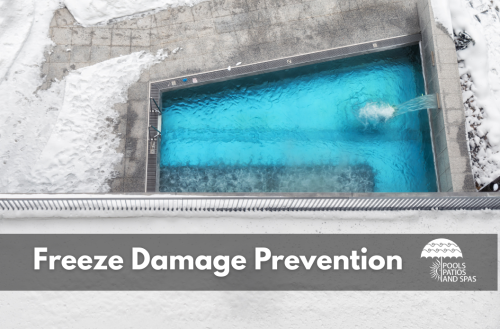
A fiberglass pool winter weather guide for Pools, Patios, and Spas customers
Coastal North Carolina does not get long, brutal winters very often, but when snow and a hard freeze hit, pool equipment becomes vulnerable fast. If temperatures drop below freezing, the biggest risk is not the snow itself. The risk is water sitting still in pipes and equipment, freezing, expanding, and cracking components that were never meant to handle ice. That is why Pools, Patios, and Spas recommends keeping your pool pump running during a freeze.
When water moves, it is far less likely to freeze inside your plumbing. Running the pump keeps water circulating through your lines, filter, heater, and other equipment, which helps prevent ice from forming and causing damage. Learn more about pumps here.
Why running the pump matters during a freeze
Moving water is harder to freeze
Water that is circulating stays more uniform in temperature and resists freezing compared to water that is stagnant in a pipe. Even when the air temperature drops quickly overnight, circulation helps reduce the chance of freeze damage inside plumbing lines.
Freeze damage is expensive and usually avoidable
When pool plumbing freezes, the expanding ice can crack:
• PVC pipes and fittings
• Pump housings
• Filter bodies and unions
• Heater manifolds and internal components
• Valves and chlorinators
These failures are not “small leaks.” They often show up as major cracks and broken parts once the ice thaws.
Fiberglass pools still rely on the same plumbing and equipment
Fiberglass shells are durable and popular in coastal environments, but the shell is not the problem in a freeze, the equipment pad is. Your pool still depends on exposed plumbing, pumps, filters, and optional features like heaters and water features. Those are the areas at risk when temperatures drop below 32°F.
It protects more than just the pool
If you have a heater, salt system, UV, automation, waterfalls, or water features, keeping water moving helps protect those components too. Any equipment that holds water can be vulnerable if it is not circulating or properly winterized.
What we recommend during a coastal NC hard freeze
Keep the pump running continuously
If freezing temperatures are expected overnight, run the pump 24/7 until temperatures rise safely above freezing. If your system has a freeze protection feature, confirm it is enabled and set correctly.
Use a steady, consistent flow
A normal running speed is usually enough, and higher flow can be beneficial for keeping water moving through more plumbing. The key is consistent circulation.
Do not rely on “we never freeze here”
Coastal NC freezes are rare, but when they happen, they are often sudden. That is when people get caught off guard and equipment damage spikes.
Common questions
Won’t my pool freeze if I keep the pump running?
Your pool surface can form a thin layer of ice in extreme conditions, but the major concern is equipment and plumbing freeze damage. Circulation is one of the simplest ways to reduce that risk.
Should I cover the equipment?
A cover can help block wind chill around the equipment pad, but it is not a substitute for circulation. If you do cover anything, keep it breathable and safe. Do not block ventilation around heaters.
The bottom line
For fiberglass pool owners in coastal North Carolina, a sudden snow event and hard freeze is not the time to experiment. Keeping your pump running is one of the easiest, most effective steps you can take to help prevent frozen pipes, cracked equipment, and expensive repairs.
Quick “Freeze Night” checklist
• Pump running, continuously
• Freeze protection enabled, if applicable
• Water level is normal
• Heater area has proper ventilation, if you use one